
Subscription tracking in India is no longer just about Netflix and Spotify. Today, recurring payments can run through cards, UPI AutoPay, wallets, FASTag top-ups, insurance premiums, SIPs, and app store renewals. If you do not track them systematically, money leaks happen quietly. The average Indian urban consumer now manages 8-15 active subscriptions, and the total monthly spend can easily exceed ₹2,000-5,000 without careful attention. A good system is vital—explore our recommended personal finance tool stack to help automate this.
Why Recurring Payments Feel Harder in India
India has multiple rails for recurring transactions. RBI's e-mandate framework covers cards, PPIs, and UPI, while NPCI's UPI AutoPay supports recurring collections for categories such as OTT, utilities, EMIs, insurance, and mutual funds. That convenience is excellent for payments, but it also means renewals are spread across more surfaces than a single bank statement.
The complexity increases when you consider that different subscriptions renew on different cycles - some monthly, some quarterly, some annually. Some are tied to credit cards, others to UPI mandates, and still others to wallet balances. Without a centralized tracking system, it's nearly impossible to have a clear picture of your recurring financial commitments.
Card mandates
Recurring payments may run through your debit card, credit card, or wallet-linked mandate.
UPI AutoPay
UPI now supports recurring collections for many bill types, making renewals easier to miss if you do not audit them.
Mixed renewal cycles
Indian users often have monthly, quarterly, and annual charges across banks, apps, and merchants.
Hidden subscriptions
Free trials that convert to paid, app store subscriptions, and family plan shares create additional complexity.
The 5-Step Subscription Tracking System
Following a systematic approach ensures you never miss a renewal and always know what you're paying for. Here's a proven framework for Indian users:
1. Build a master list
Start with the last six months of card, bank, and UPI transactions. Search for repeated merchant names, identical amounts, and predictable billing dates. Look for keywords like "Netflix," "Spotify," "Amazon Prime," "Disney+," "Gym," "LinkedIn," "Adobe," and other common subscription services. Also check for recurring utility payments, insurance premiums, and investment SIPs.
2. Separate mandatory from optional
Categorize each subscription as essential or non-essential:
- Mandatory: insurance, SIPs, utilities, credit card bills, education tools, health apps
- Optional: streaming, AI tools, fitness apps, gaming, cloud storage, memberships
This separation helps you make informed decisions about what to keep and what to cancel during financial planning.
3. Tag annual plans clearly
Annual renewals are where most users get surprised. The charge does not appear every month, so your memory treats it as non-existent. Add annual plans to a renewal calendar 30 days in advance. Many apps offer significant discounts for annual billing - make sure you're tracking these to evaluate whether the upfront cost makes sense.
4. Note the payment rail
Write down whether the mandate is on UPI, card, or wallet. This matters because revocation and troubleshooting are often different. For UPI AutoPay, you can manage mandates through your UPI app. For card mandates, you may need to contact your bank. Understanding the payment method helps you take quick action if needed.
5. Review once a week
A 10-minute weekly review is better than a large monthly cleanup. Look at upcoming renewals, identify inactive subscriptions, and decide what to cancel or downgrade. Use this weekly check to verify that new subscriptions you signed up for are still providing value.
What to Include in Your Subscription Tracker
A comprehensive subscription tracker should capture key details that inform your decisions:
| Field | Why it matters |
|---|---|
| Merchant name | Makes repeat charges easy to spot |
| Monthly or annual cost | Lets you compare actual yearly burden |
| Renewal date | Prevents surprise debits |
| Payment rail | Useful for revoking UPI or card mandates |
| Keep / cancel decision | Turns tracking into action |
| Usage frequency | Helps identify underutilized subscriptions |
Common Subscription Categories in India
Understanding the typical categories helps you audit more effectively:
- Streaming (OTT): Netflix, Amazon Prime Video, Disney+ Hotstar, SonyLIV, ZEE5, JioCinema
- Music: Spotify, Apple Music, JioSaavn, Gaana
- Cloud Storage: Google One, iCloud, Dropbox, OneDrive
- Productivity: Microsoft 365, Adobe Creative Cloud, Notion, Slack
- Fitness: Cult.fit, Fitpass, Nike Training Club
- News & Magazines: The Hindu, Times of India digital, Medium
- Investments: SIPs, NPS, premium research tools
Where Essara Fits
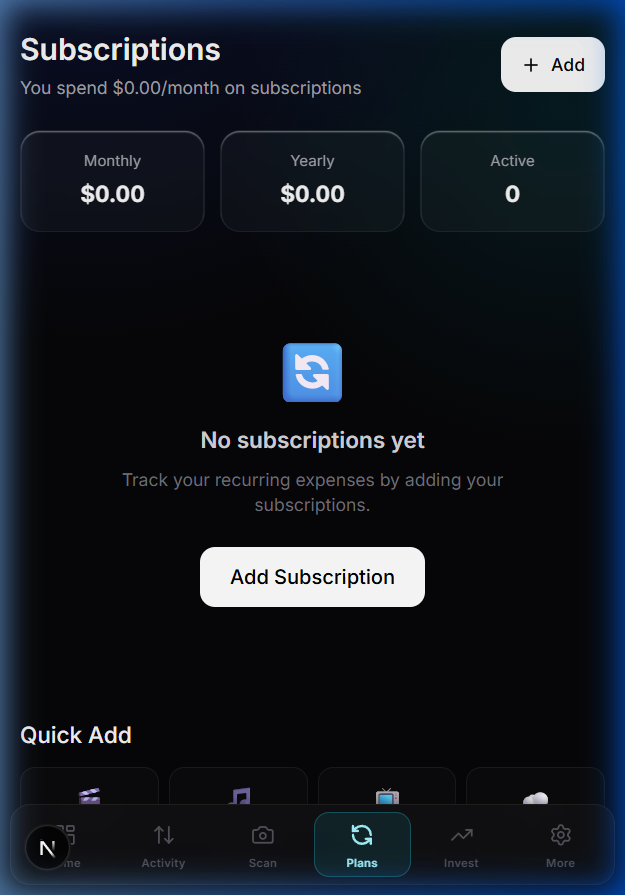
Essara is especially useful if your problem is not just finding subscriptions, but deciding what to do with them. Instead of a simple list, you get a workflow for recurring spend, reminders, supporting receipt records, and overall budget context. The app automatically detects recurring charges from your transaction history, categorizes them, and provides alerts before renewal dates.
The key advantage is having subscription data alongside your expense and investment data. When you can see that you're spending ₹3,000 monthly on subscriptions while your investment contribution is only ₹5,000, it creates a clear picture that prompts better decisions.
Subscription control is not about counting apps. It is about regaining decision-making speed.
If your renewals are scattered across cards, UPI, and app stores, sign up for Essara to keep them in one subscription workflow with clearer monthly context.